
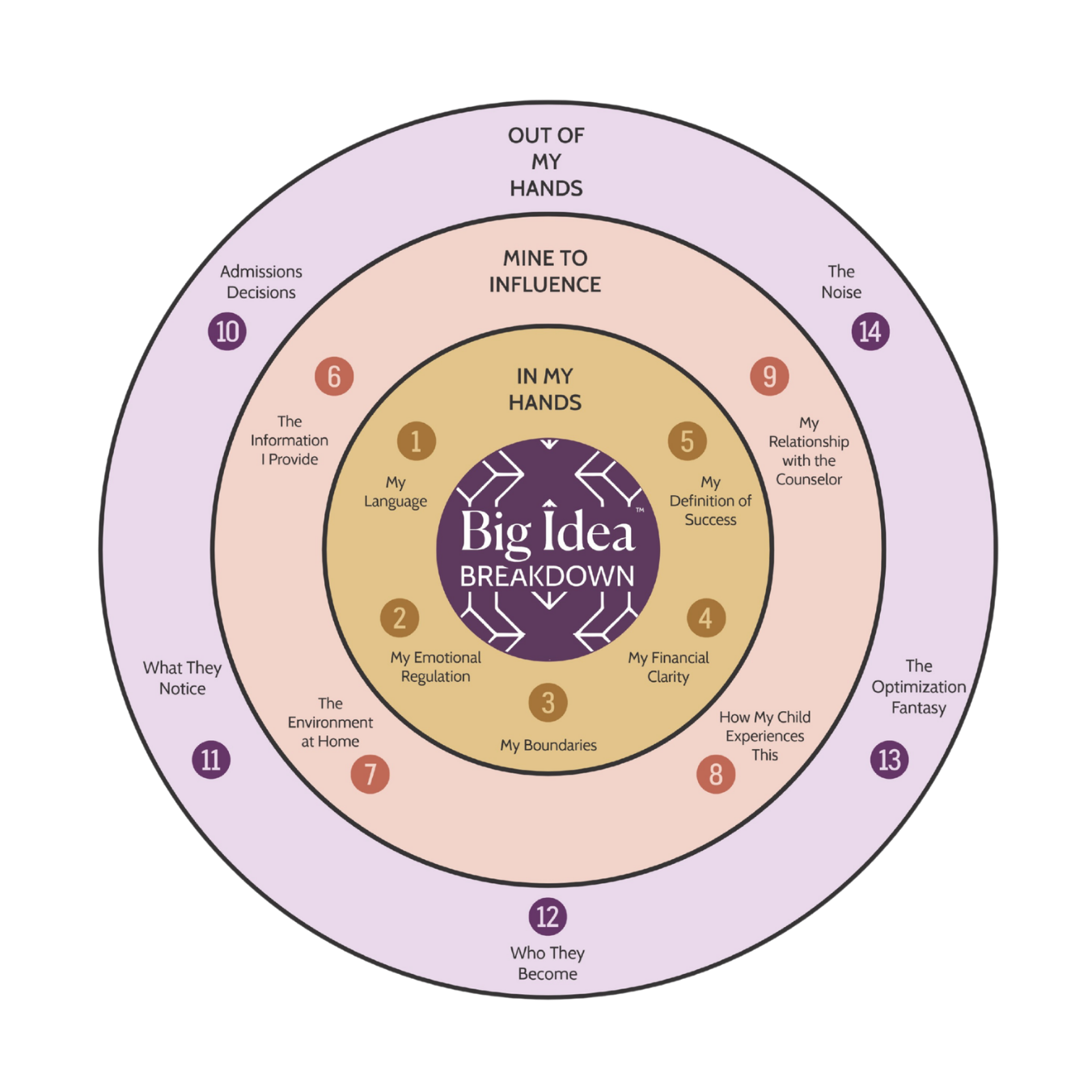
How Big Idea Breakdown Works The college process gives students repeated practice figuring out what is theirs to decide, what they can influence, and when their effort is being misdirected. Big Idea Breakdown gives them a question to return to:
Where are your hands?
The question asks them to locate themselves in the decision—and put their effort accordingly.
Once they learn to do that, the skill travels with them into adult life.
In My Hands
The choices that belong to me
Partly in My Hands
What I can affect but cannot control
Out of My Hands
Not up to me—wasted energy
The point is where the effort goes nextA student who has spent months trying to reverse-engineer what an admission committee wants has put real energy into a decision that ultimately belongs to someone else. When she stops trying to control that decision, the energy does not disappear. It goes into the essay she was avoiding because it required her to say something true, or into the conversation with her parents about money that everyone had been postponing, or into a list of schools she assembled rather than inherited.
The Intervention is Redirection
The rings come back whenever the work gets misplaced. A counselor hears a student worrying about an admission decision and asks, Where are your hands? A parent starts managing a choice that belongs to the child and gets the same question.
Eventually, the student asks it without us.
The framework builds from there. Students use the same logic to think about fit, effort, pressure, tradeoffs, and the choices that accumulate into a college decision.
The college decision is an ending. Knowing how to choose is a beginning.
xo, Mindy
Essays about parenting, culture, and the transition to adulthood.
Follow Mindy on Substack
The Bridge
Field notes on Chinese student mobility and international admissions.